-
May 23, 2011
New iPhone Ringtone: Nyan Cat

I kinda got tired of the Guile ringtone on my iPhone, so I made a Nyan Cat one. You can have it too! Get it here.
-
May 19, 2011
Threadless Shirt Meme: Pianos That Aren’t
There are a few memes that are pretty regularly printed on Threadless. Stuff like pop culture references turned into puns, things with cute faces (which normally don't have faces) and birds are among the popular subjects of Threadless shirts. I just noticed another one while browsing the site for shirts during the summer $12 sale (which has been extended to Friday): pianos that aren't.
Item 1: The Choir of Antarctica
Item 2: Piano Skyline
Item 3: The Pianist
Are there any that I missed? Lemme know in the comments!
-
April 29, 2011
Delayed Gratification in Engineering and Entrepreneurship
I read a blog post about Engineers and Delayed Gratification a while ago from ex-Googler and ex-Microsoftie Ninane Wang that made me think. She says that new engineers (like straight from school) have a hard time adjusting to the real world because they expect to be rewarded immediately for their work. In the real world, you don't see rewards for your work for months, or even years! Her solution is to have managers provide instant feedback to their reports so they get at least some acknowledgment of their work.
Since quitting Microsoft and setting out on my own (and even before that), I've had to trust that the stuff I am working on is meaningful and worthwhile. This is hard sometimes, especially if the thing I'm working on seems like a gamble. Having done the whole independent hacking thing for a while, I think I've built up the rolling reward cycle that Niniane mentions. Some days I'll feel like I'm underachieving or working on something that no one will find useful. Then I'll get a donation from someone for Instascriber (this actually happened!!!) or see another 5 star review for my Threadless app and get re-encouraged.
At the end of the day, I think what really separates the employees from the entrepreneurs is the willingness to be unsure about something and still do it. The uncertainty is much greater when you're working on an unproven idea, business model, or whatever, but then so are the potential rewards, too. And even if you end up failing, you learn something and are better for it.
In some ways, delaying gratification even sort of makes sense. If you immediately were rewarded for doing something innovative, you might lose the passion (like Rocky did) and stop innovating so you can enjoy your riches. While I can't say that delaying gratification indefinitely would be a good idea, accepting that there will be a delay is probably healthy.
-
April 25, 2011
The Internet Is For… Downtime.
These last few weeks have been really, really bad for the internet. I mean, in general. What with Media Temple going down due to their nameservers, Amazon EC2 going down, and also the Playstation Network refusing to let me log in… You'd think there was a cyberattack going on or something.
My websites did not manage to dodge all of the bullets either. A few sites were down from the Media Temple thing. I also inadvertently broke a few sites here and there. After the Media Temple downtime, I wanted to try updating a few Ruby Gems to get Passenger Phusion working. Unfortunately my rails apps hadn't been updated in forever, so updating things broke backwards compatibility. I've been working on getting Anime Nano back to full capacity on the newest version of Rails. I think the whole experience was a bit stressful, but probably ended up being good in the long run.
I was also surprised to see Mapskrieg going down late last week. Apparently I hadn't verified the domain for Google Apps and Google decided to close my account. The one that was serving Mapskrieg via App Engine. This was really annoying since all of the “act now or we'll delete your account” emails were classified as spam in gmail and I am pretty sure I had verified the account previously. If Google doesn't want my money then screw them. I figure I can actually serve the site for cheaper than App Engine since a few other apps live on the same server. The App Engine thing was a fun experiment but there are still too many limitations in the datastore to base a real app on it. Specifically, datastore writes cost way too much and indexes take way too much overhead in disk space (which you eventually need to pay for).
So now I'm back to running most sites on Media Temple, though I may diversify in case Media Temple continues to have downtime issues. It was a stressful few days, but at least I got to practice my sysadmin skills a bit and update my server in the process.
-
April 08, 2011
Mapskrieg iPhone/iPad App Launch!
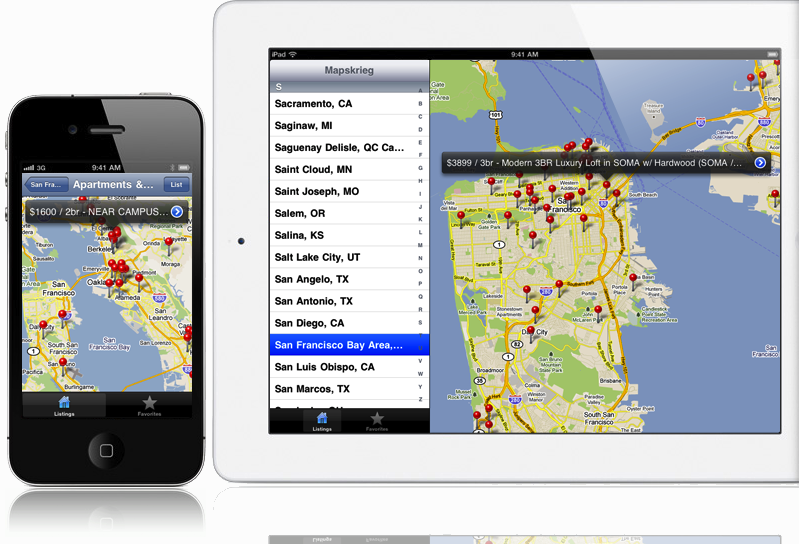
It's been about 4 years since I announced the launch of Mapskrieg, my Google Maps and craigslist mashup web app. Since then, I've gone to school (again), worked for Microsoft and quit, and made a few apps. Today, I'm happy to announce the launch of my newest app, Mapskrieg for iOS!
I've been working on this app for a few weeks, and I think it's ready for public consumption. It's basically Mapskrieg, but developed natively for the iPhone and iPad. In the past, I've taken a sort of iterative approach of releasing fairly minimal apps and improving on them. For example, I released Threadless as an iPhone only app and later added the iPad support. I wanted to release Mapskrieg on both platforms so the launch would have a little more bang. Plus I think the iPad app is the better of the two, and I really wanted that one to stand out for the release. I've been getting much more comfortable with mobile development, and I'm very happy with the rate at which I was able to conceive and release this app.
That's not to say I didn't struggle or learn anything new with it. While a lot of the concepts are borrowed from my Threadless iPad app, I had to do a lot of stuff I hadn't done before. For example, since Mapskrieg is going to rely on iAds to make money, I decided that both the iPad and iPhone versions would support iAd. Apple, in their infinite wisdom, made the split view controller a very useful and now, standard, design paradigm. Unfortunately, they don't provide any support for using it with iAd at all. What the fucking fuck, Apple!? So I had to basically recreate the Split View (well, the landscape mode at least) in order to support iAds. It'll be well worth it if I can rake in some iAd dough, though!
This post also comes almost 1 year after I quit my job at Microsoft. That milestone probably deserves its own post, but I'll just say that I have not yet regretted my decision in the very least so far. This is as fun as it gets, folks!