-
September 09, 2010
What I Learned From Checkmate
Just about two weeks ago, I released my first paid iPhone app, Checkmate. The experience has been priceless, plus I made a few bucks as well. I thought I'd share the stuff I learned, both technical and otherwise.
Technical:
Core Location. Being the first iPhone app I've done that uses Core Location, I learned a lot about the process of starting up the location manager, filtering location updates and getting them to work in the background. The background stuff is pretty new, just released in iOS 4.
Design takes thought. One of the most difficult things in designing an app is balancing between user expectations (“it should work like magic”) and real-world constraints (battery, accuracy tradeoffs). I've taken the approach of leaving the details under the hood (another app that does something similar gives users full control) for simplicity. This is a deliberate design decision. I've found that many users are happy with the app, and some are unhappy. I assume there is a minority that is unhappy, but that they seem to be more vocal (more on that later).
Core Data. I also learned about Core Data, since I use that for storing venue data persistently. There's a bit of a learning curve with Core Data, but I have a pretty good idea of how it works. I guess it helps that I've designed a bunch of database schema in the past.
Get to good enough. I definitely feel like I have accomplished something by releasing the app. I have wrestled in the past between releasing something when it's “good enough” but not getting stuck in perfectionist limbo. In the case of Checkmate, I got to a point where I was happy enough with its performance (it works) and did not want to delay any further, lest I lose steam and give up on ever releasing it. Now that I've gotten a feedback loop going, it'll be easier to improve and update the app anyway. As far as interface design goes, the app is a bit clunky for my taste. Having admitted that, I think I could go back and make some things more obvious (like the login screen) and polish up the user experience.
Business-ey
Ask for reviews. Ask satisfied customers for reviews. Because if you don't, only the unhappy users will post them. And you'll end up getting a pretty bad average rating. Even if your app makes crap into gold, there will be users who don't see the value in it, or think that $2 is too much to pay. Encourage users to post reviews in-app and you'll see a well-rounded view of what people think about your app.
It's okay to have a competitor. While developing my app, I found that another similar app had launched and gotten some press from Techcrunch. This was a bit depressing as I wanted to have that exposure. I ended up using it as a motivator since the blog post and app validated my own idea. There's always room for competition, especially if you can outdo them.
Popular takes all on the App Store. There have been blog posts on the subject of iTunes ranking and how valuable it is to make a top 100 list. Apps seem to be ranked in search based on their sales volume, which means that popular apps will become more popular. Having been featured on Mashable at launch, my app got to #2 for a “foursquare” search. This helped a lot for residual sales. I'm assuming that most apps are sold directly from app store searches. There are other ways to discover apps.
Have fun! It was really exhilarating to see my app get into the app store and into the hands of users. I set up a twitter account to communicate with users, monitored twitter searches for my app and answered emails sent through a contact form on my website. It was really fun having people react to work that I did. It's probably one of the strongest motivators for me to keep doing what I'm doing.
I have learned a great deal from my first commercial app launch. I'm really glad that I had an idea and stuck with it to completion. I'm still learning a great deal from Checkmate. I know that this experience will make the launch of my next product/app (whatever it might be) more smooth, both for me and users!
-
August 25, 2010
Checkmate for Foursquare (for iPhone) Release!
My second iPhone app, Checkmate, just got approved in the Apple App Store last night. It's an auto-check-in app that runs in the background. You select your favorite venues, and Checkmate will check you into them when you get close enough, even when the phone is still in your pocket! I wrote this app because I got annoyed at forgetting to check into places on foursquare while there.
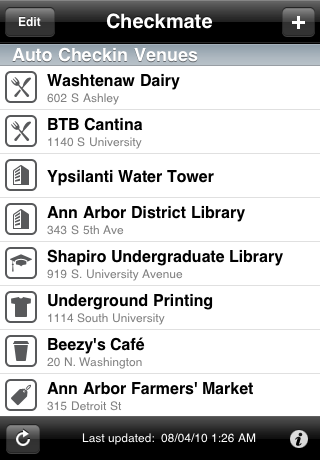
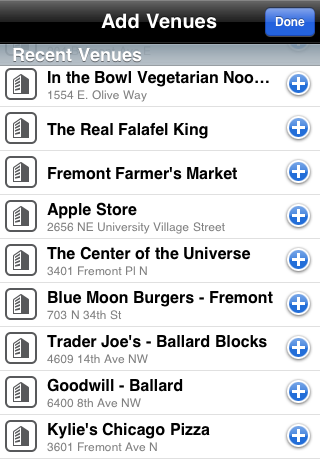
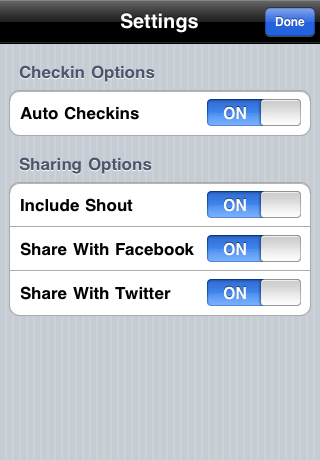
If you'd like to get Checkmate, you can buy it here for the low price of $2. For more info, check out the official website I made for it. And follow Checkmateapp on Twitter for news on the app.
-
August 17, 2010
Stupid Data Tricks: Facebook Names
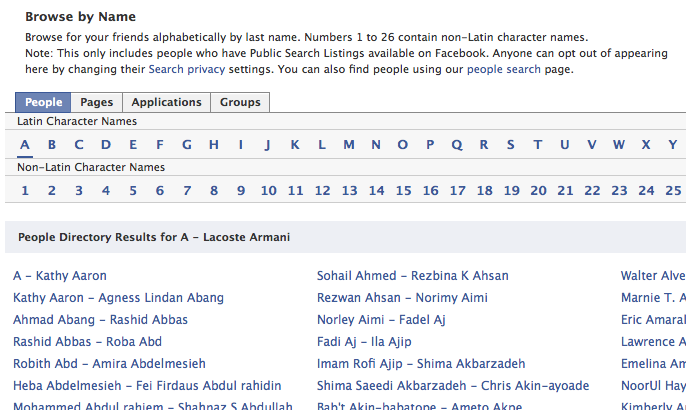
Like a good data nerd, I downloaded the list of publicly available Facebook names, dumped into text files. I was trying to figure out a neat way to use them. It's always weird when people have the same first and last names, so I wrote a quick regex to find people with names like “John John” and “Laura Laura.” I used /^([a-z]+) \1$/, but maybe there's a better one. I think mine left out the middle names.
Apparently there are a lot of people with the same first and last name. 14,495 in my list, to be exact. But that's out of a 100 million or so (I only did unique names). Here's the list for anyone who might care. I'm trying to figure out a more useful application for this dataset. Any ideas?
-
August 15, 2010
What Happened to Yahoo (and What Could Happen to iAd)

I recently read an essay by Paul Graham on what happened to Yahoo. In it, he describes how Yahoo acted like a media company when it was really technology company, and how funky management made it into what it is today. One quote struck me as relevant today:
By 1998, Yahoo was the beneficiary of a de facto Ponzi scheme. Investors were excited about the Internet. One reason they were excited was Yahoo's revenue growth. So they invested in new Internet startups. The startups then used the money to buy ads on Yahoo to get traffic. Which caused yet more revenue growth for Yahoo, and further convinced investors the Internet was worth investing in. When I realized this one day, sitting in my cubicle, I jumped up like Archimedes in his bathtub, except instead of “Eureka!” I was shouting “Sell!”
Having just integrated iAd into one of my iPhone apps I've noticed that pretty much all of the ads are for other apps. Most of these apps are “free,” and I assume that they could potentially be using iAd for revenue as well. This is a result of low fill rates for iAd and Apple wanting to offer developers a way to advertise their apps. It makes sense, but one has to wonder exactly where all the money is eventually going (Apple gets a 40% cut of iAd revenue), and who has the incentive to keep that system running.
A while ago I wrote my predictions for iAd. I didn't foresee Apple opening iAds up to developers who wanted to advertise their apps. That'll help the fill rate, but I can't see it helping CPMs when developers have something like a $0.25 CPC and it was reported that the larger media campaigns like Dove were closer to $2 CPC. Seems like another race to the bottom, just like paid app prices.
-
August 13, 2010
Hung Truong on The Radio!
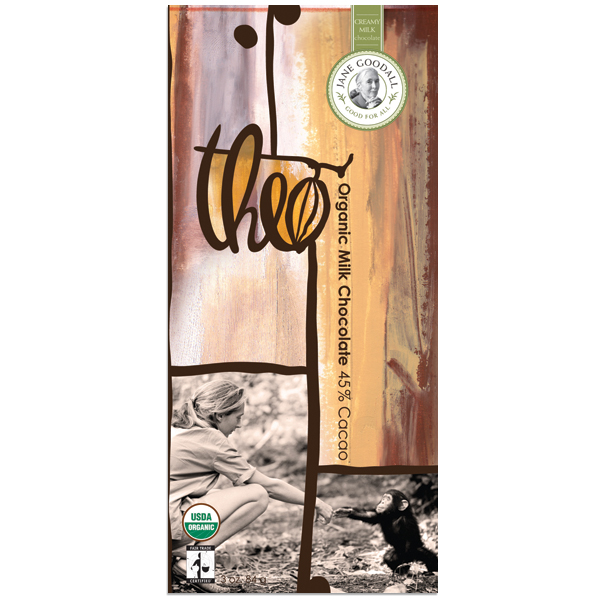
A few months ago, when I was living in Seattle, I went with my .gf and friend to a tour of Theo Chocolate. It's a chocolate factory about two blocks from where I used to live that does organic chocolate. On the day of our visit, a news reporter was doing a radio spot for NPR on the factory. She asked to follow us around and we told her that was cool.
I looked for the spot for a while online, but I couldn't find it. Just now, I was looking at searches on how people get to my website, and I found one misspelled query for “Hung Troung” that I followed and led to this blog post. It's the news report that I appeared in so long ago!
I guess the lady didn't have a lot to talk about because she used a lot of my random quotes. One of the funniest things that happened on the tour was this little kid (maybe 8 years old?) who kept on spewing non-sequiturs like “My uncle has a tree” and “I like pie” when asking questions. He reminded us of the I Like Turtles kid. I wish the reporter had gotten him in the story.
I also remember the tour guide being a little over the top. Like in terms of being dramatic and stuff. I remember hearing someone say that she just got back from doing some audition, so maybe that was why.
When the factory found out that the reporter had been following us around the whole tour, they felt sorry for us and got us some boxed confectionary candies. That was really nice. I think they were like $20 each or something and we got one each. Score! Thanks, Theo!
Oh, and I think it's kind of apparent that I mumble a lot, or maybe I was just nervous. I should work on that. Here's the audio of the story and the transcription (Fair use?): Note: I lost the mp3!
Remember Charlie and the Chocolate Factory? Where four lucky kids win a tour of Willy Wonka’s secretive candy plant? Well, Theo Chocolate isn’t that exclusive—but you better call ahead.
Just one measure of its success; it’s tours are booked solid.
Hung Truong: “Make sure you call ahead because the tour’s so popular. I think I reserved like four weeks or something in advance? That’s really early.â€
Hung Truong came to Theo Chocolate to see where the candy he buys is born.
Hung Truong: “Oh wow the fig one is good.â€
Kate Kraay, leads this tour of about 20 visitors. Buzzing about each step of the chocolate bar’s creation.
Kate Kraay: It's this process of slurping up the chocolate from the bottom, spraying it up and around the sides; this is the closest thing that we have to Willy Wonka’s waterfall of chocolate.
How did a company just four years old navigate through the recession? Vice President of Sales and Marketing Deb Music says one factor is the price.
Theo bars run about $3 a piece. That's proven to be not too high and not too low. Another ingredient to success is that Theo bills itself as the first organic, fair trade chocolate factory in the US. That plays especially well in the northwest.
Music says founder Joe Whinney's decision to relocate to Seattle from the east coast has been a golden ticket.
Deb Music: “I think our values at this point are very progressive and in line with a lot of people's values here and I think the company is inspiring because we're really trying to effect positive change in the world.â€
Music says overall the company grew by 21 percent last year, despite the rough economy. And for the first part of this year Music says Theo has seen significant growth – around 25 percent – over 2009.
Curtis Vreeland is a confection industry analyst from Pennsylvania. He says while the chocolate industry isn't recession proof, it is recession resistant.
Curtis Vreeland: “The overall premium chocolate market is struggling, but they're layers in there which are doing well. And those would be where Theo is and those companies that are sort of in the gourmet section, but not the high-end.â€
Another sweet spot for Theo is its identity.
Curtis Vreeland: Once you've bought into the ethics of those kind of bars – organic and fair trade – you're not going to shed your ethos in a recession. You may buy less. I think when the country comes out of the recession they'll be buying quite a bit more.
Back at the tour at Theo Chocolate, Hung Truong says it's worth the price.
Hung Truong: There's like a psychology thing there, where you might not be able to afford the best things all the time, but you can afford something that's really nice some times. And it's just like what $3 for a bar? You're treating yourself, and you're not breaking the bank.
By the end of the tour Truong is left with only one worry.
Hung Truong: I think those little kids disappeared. It's oddly like Charlie and the chocolate factory. Did one turn into a blueberry? What happened to them?
I'm Chantal Anderson reporting.