-
June 25, 2010
Rework: Book Review
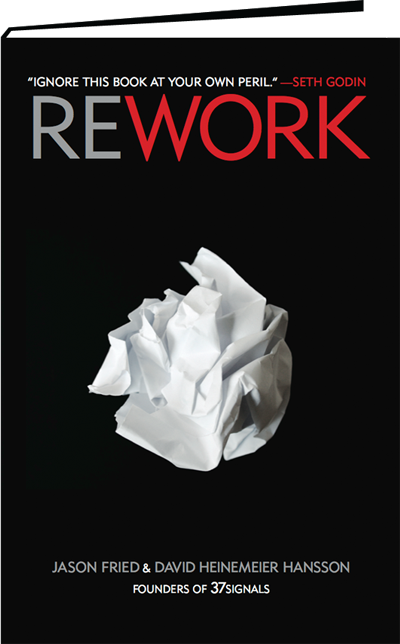
Rework, a book by 37signals (the guys who made Ruby on Rails), is a pretty simple book. It's appropriately simple, because the book is almost entirely about simplifying things, and the positive effects of doing so.
I started reading the book in a protected PDF from the Microsoft library a while back. Unfortunately the license expired before I read the whole thing, so I grabbed a copy from the Ann Arbor library and finished it up. The book is incredibly easy to read and also incredibly short. It clocks in at a deceptive 273 pages. In reality, there is probably more illustration and whitespace than actual text. It feels like 37signals took general ideas from their blog and distilled them into super short nuggets of information.
I think that the ADD-like feel of the book both helps and hinders. It drives home the point that you don't need a lot of words to explain something. You can just be simple, and it'll work. Personally, I feel it's too easy to blaze through the book and really forget most of what was read since it's so fast paced. Good thing I basically read through it twice.
For the most part, I agree with most of the sentiments in Rework. The general message is that you don't have to act like every other company out there. You don't need to be obsessed with getting big, stalking the competition, hiring billions of people, etc, because being small is actually pretty nice. You can build something that just works, and from there, improve on it. The alternative is taking forever to build a monolithic beast and then finding out you didn't need all those features.
One interesting thing that I read about in the book was in a section about having “less mass.” The book explains that:
From here on out, you'll start accumulating more mass. And the more massive an object, the more energy required to change its direction. It's as true in the business world as it is in the physical world.
What's interesting is that my former manager who had something like 20-30 years of experience in the industry had used this analogy to explain why my former company was moving so damn slow. He's a manager that I truly respected and it's just kind of funny seeing how common a theme mass and inertia is.
Within the context of my most recent work experience, Rework actually points out a lot of what was wrong in the culture. I could go on about it, but that's for another post. I would encourage you to read the sections: “Meetings Are Toxic,” “Strangers at a Cocktail Party,” “Illusions of Agreement,” and “Send People Home at Five.” As for what went right, Rework did touch on some of that, too (“Focus on What Won't Change,” and “Say No by Default”).
More recently, I've been trying to take the ideas in Rework and apply them to whatever I'm currently doing. I released an iPhone app just a while ago that was barebones. I got a lot of good feedback and learned a bunch about how the App Store process works. A few days ago I submitted an iPad version of that app. It's also pretty bare, but I know I have room to improve and possibly even start making money with it.
I think that Rework is especially relevant if you are a “starter” type of person, or would like to have that kind of culture at work but aren't sure how to go about it. I would suggest this book to anyone who works, though. If nothing else, it's a good way to keep an open mind on alternative perspectives regarding business and business culture.
-
June 15, 2010
Yo Dawg, I Herd You Like Apple Stores
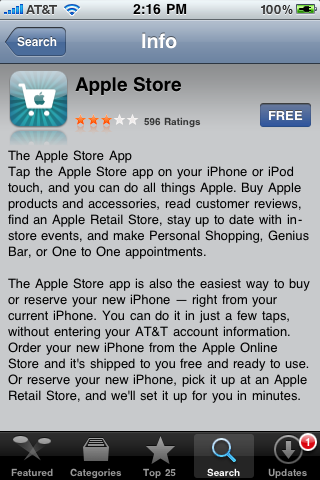
So we put an Apple Store in your App Store so you can buy iPhones on your iPhone.
-
June 11, 2010
Marmaduke: The Movie

I have just learned that there is a Marmaduke movie. Apparently it involves talking dogs. Immediately I wondered if there would be a derivative movie: Joe Mathlete Explains Marmaduke The Movie. The tagline would probably be “Marmaduke is an asshole.” I guess the guy has known about this movie for a while and wrote a tl;dr essay about it.
Previously: Joe Mathlete Explains Today's Marmaduke
-
June 10, 2010
Chase Bank Treats You Like A Child

I went to the bank yesterday to fix a $12 fee that shouldn't have been there. I kept getting random offers and shit that I really didn't want to hear. Like the teller kept trying to show me how to do bill payment through Chase Bank and my credit cards (also through Chase).
Apparently the reason for the $12 service fee was that my accounts weren't properly linked. The teller asked her manager if the fee could be reversed and then told me that he could reverse the fee if I agreed to be shown how to do the online bill payment (I had to log in on their computer). I probably should have just threatened to close my accounts, but I didn't want to waste more time.
Needless to say, the experience wasn't a good one. I'm closer to closing my Chase accounts than ever before. I'll probably find a new bank before I do so, though. I really hate how pushy Chase is to try and get me to open more accounts, use their stupid bill pay and use their debit cards (which I never do). The worst thing is that all of these “offers” increase the line wait time and just wastes their customers' time. Definitely not the way to do customer service.
Anybody know of a good bank that has branches and ATMs in Southeast Michigan?
-
June 07, 2010
Delivering Happiness: Book Review

I received an advance copy of Delivering Happiness: A Path to Profits, Passion, and Purpose by Tony Hsieh, the CEO of Zappos. I am posting the book review today because it's also the official release date of the book! It's also the day before my birthday, but that doesn't really have anything to do with this review.
I saw Tony speak at a keynote for the SXSW conference in 2009. The key components of that talk have stuck with me ever since. He basically argued that companies should act more like people. Since they're made of people, they need to act more holistically while considering more than just revenues. His company, Zappos, has the goal of delivering WOW experiences through service. Basically it's to make people happy through unbeatable customer service.
I was glad to see that Tony decided to distill that talk (and much more) into book form a little more than a year after his SXSW talk.
The book is mostly a narrative about Tony's path to becoming an entrepreneur, angel investor, and eventually CEO of Zappos and getting bought by Amazon.com. I say this book is mostly narrative because about halfway through it starts becoming something else. The narrative is funny and quirky, something I'd expect from a guy whose company has a core value of “Create Fun and a Little Weirdness.” He talks about buying worms for a worm farm, then starting a mail order button empire as a kid, which led to selling pizza in college and then creating LinkExchange (which I totally remember using) while working for Oracle.
I feel that Tony and I share a lot in common. I also had many schemes for making money before I had a real job, like selling rocks and doing yardwork, selling Dell coupons on eBay and signing up for random online offers so I could get gift certificates to sites like CDNow (I think Amazon.com bought them). Tony writes about quitting Oracle when he felt his LinkExchange was too good of an opportunity to not devote his full time to, and quitting Microsoft when his company was sold, not waiting for his stock to vest (and losing lots of money in the process):
I didn't know what I was going to do, but I knew what I wasn't going to do. I wasn't going to sit around letting my life and the world pass me by. People thought I was crazy for giving up all that money… I had decided to stop chasing the money, and start chasing the passion.
Having recently resigned at my own (fairly high-paying) job at Microsoft, I feel the same way. Reading this book was a lot like reading about my own life, at least until the part where he figures out what he does after qutting (I'm still figuring that out, myself).
The narrative section goes up to about the point where Zappos finally ends up getting an important loan and relocates to Las Vegas. After that, the book takes a turn and starts feeling more like a business book. Tony starts including lots of email memos to show what was communicated to the employees at certain points, like when the company had to lay off some employees or when they were sold to Amazon.
Different Zappos employees start writing entire sections like “Vendor Relations by Fred.” This makes the book feel much more fragmented and difficult to follow. The book becomes less about Tony and more about a shared experience. The problem is that it's riddled with asides, lists, email memos and more. There's really no organization towards the end of the book and it feels very much thrown together. While the lessons at the end of the book might be useful, I feel as though there could have been two separate books. One from Tony's perspective that stays as a full narrative, and another book for business people on how to make sure their company's culture doesn't poison its employees.
Delivering Happiness is a good book. I believe in its author and in the principles contained within. While I feel it could have been organized better, I still think everyone should read it. It's an extremely quick read and very entertaining most of the way through. I hope that Tony Hsieh's message of the importance of company culture reaches more people, and that people have better work experiences as a result.
Disclosure: I received a free review copy of this book. My review is an honest opinion of the book.
Contest rules!
I'm also holding a contest because I got an additional free copy of the book to give away. If you want to win it, retweet this tweet and follow me @hungtruong (so I can DM you). I'll randomly pick someone to send the book to once I get enough entries (after a day or so). I can only ship to the US; sorry about that!